

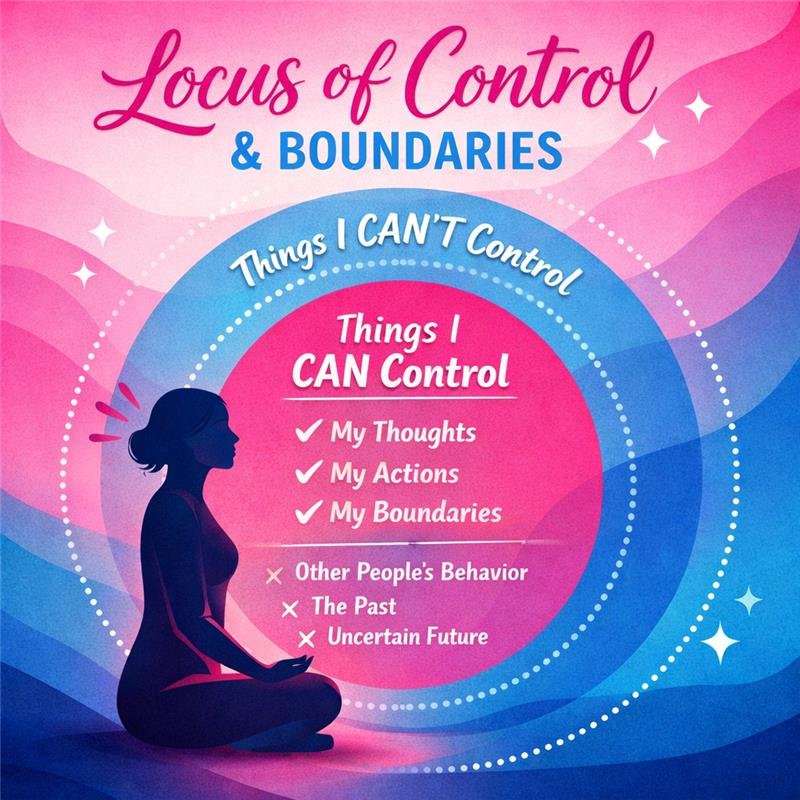
Locus of Control in Therapy
How Understanding Your Circle of Control Improves Boundaries, Confidence, and Relationships
At Myndworx, our licensed mental health providers often work with people who feel overwhelmed, emotionally drained, or stuck in repeating relationship patterns. One of the most effective therapeutic frameworks we use to address these concerns is locus of control. Learning to focus on what is truly within your control can restore a sense of stability, improve emotional regulation, and support healthier relationships.
Locus of control describes where you believe control over your life resides. An internal locus of control recognizes that your thoughts, emotions, reactions, words, and choices belong to you. An external locus of control places responsibility on other people, circumstances, or events. In counseling, the goal is not to deny outside influence but to strengthen internal responsibility and release responsibility for what is not yours to manage.
The circle of control is a practical way to understand this concept. Inside your circle are your actions, reactions, emotions, thoughts, perceptions, words, choices, and what you choose to accept or participate in. This is where your effort has the greatest impact. Outside your circle are things such as other people’s behavior, how others feel, past events, outcomes you cannot guarantee, and larger systems beyond your influence.
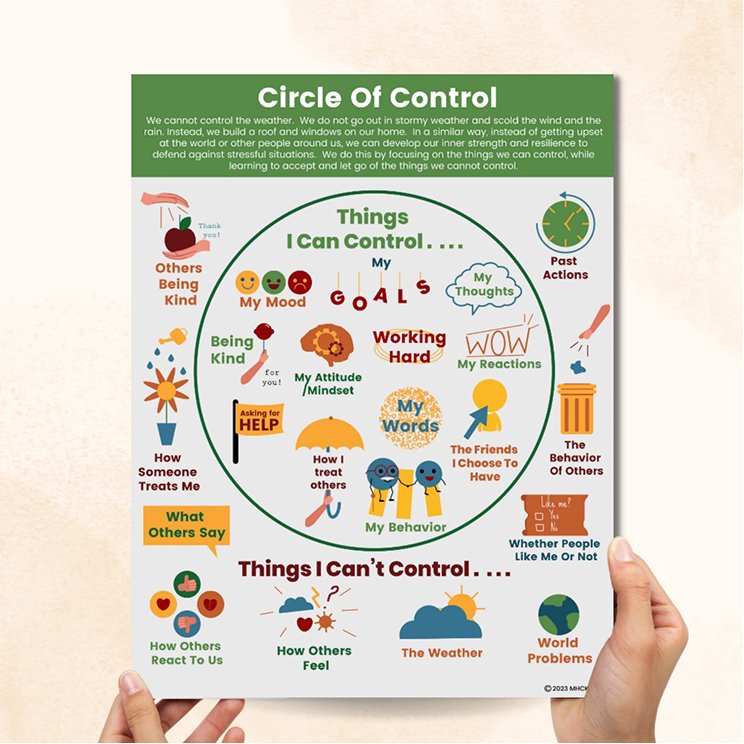
What You Are Responsible For:
Inside your circle of control are the areas where your personal power lives.
These include:
-your actions
-your reactions
-your emotions
-your thoughts
-your perceptions
-your words
-your choices
–what you accept
-what you participate in
These are the only areas you can directly manage, and they are the foundation of emotional health and self-trust.
Emotional distress often increases when people take responsibility for what belongs in someone else’s circle. This may look like trying to manage another person’s emotions, feeling responsible for keeping the peace, over explaining in order to be understood, or repeatedly fixing problems that require someone else’s change. While these patterns are often driven by care or fear of conflict, they typically lead to resentment, burnout, and strained relationships.
Understanding locus of control is essential for healthy boundary setting. A core principle we emphasize in therapy is that boundaries are for the person setting them. Boundaries are not tools to control others. They are expressions of self control and self responsibility. A healthy boundary focuses on what you will do, how you will respond, and what you will participate in rather than on changing another person’s behavior.
Boundaries apply not only to relationships with others but also to your relationship with yourself. Internal boundaries include how you speak to yourself, which thoughts you reinforce, when you choose rest instead of over functioning, and whether you continue emotional patterns that cause harm. Strengthening your internal locus of control means learning to regulate yourself rather than attempting to regulate others.
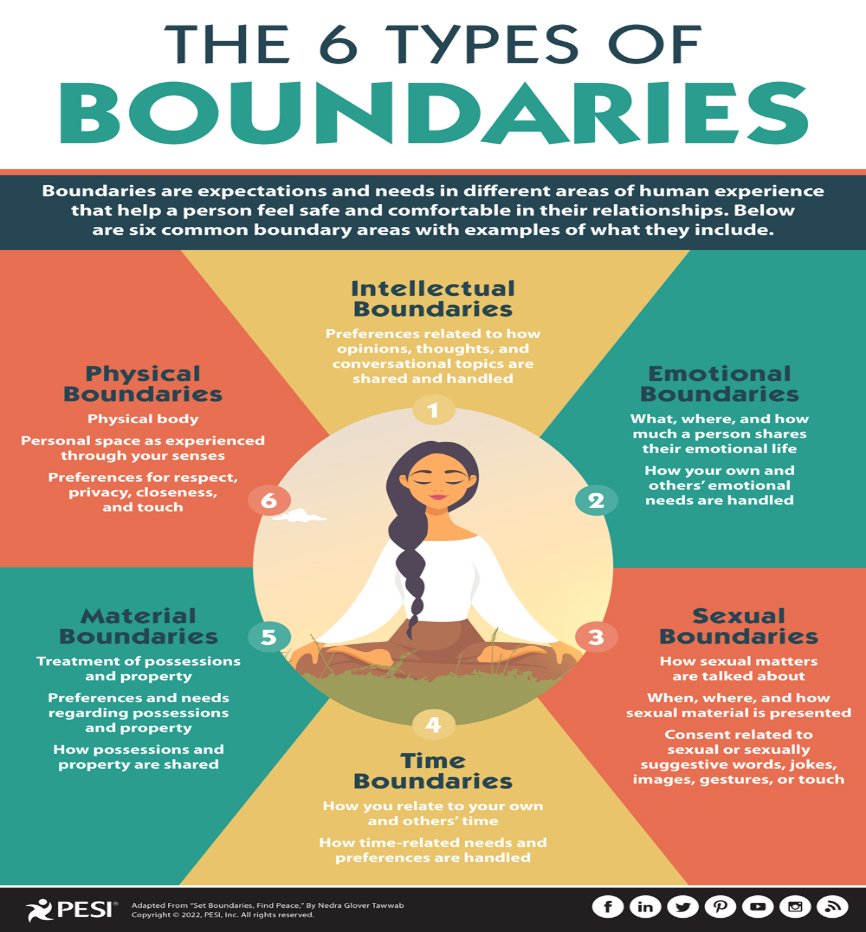
Boundaries are for the person setting them!
Boundaries are not about controlling others. They are about self-control and self-responsibility.
Healthy boundaries define:
-what you will do
-what you will not do
-how you respond
-what you allow yourself to participate in
For example: Instead of saying you need to stop speaking to me that way.
A boundary sounds like: If I am spoken to disrespectfully, I will step away from the conversation.
When stress or conflict arises, it can be helpful to pause and ask whether the issue is within your circle of control. If it is, you can take responsibility and act. If it is not, the next step is to consider whether there is anything within your circle that could influence the situation through communication, boundaries, or intentional choice. If there is not, the final step is acceptance. Acceptance does not mean approval. It means releasing the struggle to control what cannot be changed.
When individuals consistently stay within their own circle of control, relationships tend to improve. Communication becomes clearer, resentment decreases, emotional safety increases, and boundaries feel more natural and respectful. Healthy relationships are built when each person takes responsibility for their own thoughts, emotions, and choices rather than carrying responsibility for others.
Developing an internal locus of control is a skill that takes practice and support. Working with a licensed mental health provider can help you apply these concepts in daily life and relationships. If you would like to learn more about locus of control, boundaries, and emotional regulation, visit www.myndworx.net to begin counseling with a licensed provider.